
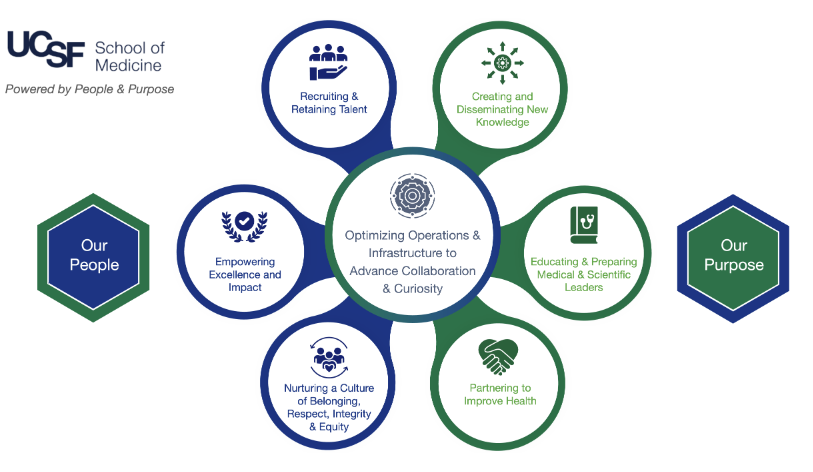
School of Medicine Strategic Plan Tactics
Build and strengthen communities of practice
Executive Sponsors: Christina Mangurian, MD, Laurae Pearson, and Sam Yee
Vision: We will cultivate a vibrant, inclusive network of Communities of Practice across the School of Medicine, where employees in similar roles connect across departments and sites to share knowledge, solve problems, and foster a strong sense of belonging—driving collaboration, effectiveness, and collective impact.
Status: Discovery is largely complete, including interviews with eight existing communities, needs-assessment surveys, and development of an initial CoP toolkit; two experiments—the Outreach & Opportunities Leaders CoP and HR Liaisons CoP—have also launched. Next steps are to finalize ownership, gather feedback on the toolkit and pilots, refine the model based on lessons learned, and develop a dissemination plan.
Links to: 
Create a deliberate process for reporting on and monitoring the culture and community of SOM
Executive Sponsor: Olivia Herbert, MBA
Vision: We will create a streamlined, organization-wide approach to measuring and understanding culture and employee experience across departments, delivering meaningful insights while minimizing reporting burden.
Status: Following the conclusion of the decade-long Diversity Accountability Report process, the team has begun a landscape assessment focused on Gallup outcomes and lessons from departments that have improved their culture measures. Next steps are to align with the O&O strategic plan and develop a preliminary scorecard with 4–5 dimensions and associated metrics for assessing healthy culture and community, while incorporating learning from other strategic plan tactics.
Links to: 
Create governance and processes at each health system to align, prioritize and resource learning health system projects
Executive Sponsor: Ralph Gonzales, MD
Vision: We will implement an integrated Learning Health System strategy that will enable more effective and sustained translation of care delivery innovations, personalized care, and evidence-based practice.
Status: The LHS Leadership Council has been established, and SOM and UCSF Health have made FY27 budget commitments supporting institute staffing, an LHS Registry, and LHS Collaboratives. The next phase is to appoint the Institute Director by November 2026, launch Collaboratives by January 2027, and develop a governance plan by March 2027 that clarifies sponsorship, stewardship, priority setting, and resource decisions.
Links to: 
Create intentional connections across geographies and disciplines
Executive Sponsors: Jose Barral Sanchez, MD, Jeff Critchfield, MD, and Dave Morgan, PhD
Vision: We will foster a thriving SOM community where people feel connected to one another and understand the meaningful impact of their contributions to UCSF's excellence.
Status: The team has identified three interventions: communities of practice for clinical and education faculty, a “Ride-share for Research” approach to sharing core research resources, and enhancements to CTSI Profiles—including potential AI-enabled matching—to facilitate connections across missions and locations. Next steps include identifying site-based CoP leaders and coordinating committees, inventorying available research resources, and further developing mechanisms that proactively connect faculty with relevant collaborators and opportunities.
Links to: 
Develop a consistent philosophy about what decisions and work are centralized versus decentralized
Executive Sponsor: Maye Chrisman, MBA
Vision: We will build a connected SOM where a shared, transparent framework aligns centralized standards with departmental autonomy—enabling consistent, equitable decision-making that strengthens trust, reduces inefficiency, and empowers every unit to thrive.
Status: The team has completed a landscape assessment through interviews with SOM and central stakeholders and has begun testing the approach through the Elevate pilot, using co-owners and co-leaders as the project leadership/governance model. Next steps are to form a working group from the landscape-assessment participants and use the emerging SIERA framework to establish clearer criteria for standardization versus variability, with attention to end-user input, stakeholder alignment, and institutional versus local interests.
Links to: 
Develop a culture that values clinicians as health systems grow
Executive Sponsors: Paul Garcia, MD, and Patrick Ha, MD
Vision: We will create a culture that honors the clinical contributions of faculty, differentiating UCSF from other clinical settings and develop systematic ways to celebrate and recognize clinical excellence. We will also address gaps in alignment between UCSF’s academic mission and the clinical work carried out by affiliates and UCSF Health Foundation.
Status: The team has engaged clinical and institutional stakeholders and identified potential approaches for recognizing clinical excellence, including a clinician scorecard, awards, communities/resources, and greater visibility of clinical contributions. Next steps are to refine appropriate measures—including patient feedback and performance indicators—and develop a dashboard while determining how recognition should be structured and used.
Links to: 
Develop and monitor the success of intentional paths to recruit residents onto faculty
Executive Sponsors: Karen Hauer, MD and Michael Gropper, MD
Vision: We will cultivate a strong, sustainable pipeline of UCSF trainees into faculty roles—especially in clinical fields—fostering continuity, excellence, and long-term impact across the institution.
Status: A working group and steering committee are meeting regularly, a GME retention dashboard has established baseline resident and fellow retention rates, and trainee focus groups and initial recruitment best practices are underway. Next steps include refining four high-impact priorities through Chair input, adding student data to the dashboard, completing focus groups and landscape analysis, and coordinating interventions with UCSF Health and SOM.
Links to: 
Conducting real-time feedback
Executive Sponsor: Erick Hung, MD
Vision: To strengthen retention, we will create a more continuous process to identify and intervene and address issues impacting faculty and staff experience.
Status: The team has conducted interviews with campus, department, and division groups that have implemented real-time feedback approaches, identified members for a working group, and developed key design questions to guide a centralized feedback system prototype. Next steps are to convene the working group and develop a prototype that complements existing annual surveys while enabling timely, trustworthy feedback, local responsiveness, and broader SOM monitoring of faculty and staff experience.
Links to: 
Improve performance evaluation and career pathways for staff
Executive Sponsor: Christina Cicoletti
Vision: Cultivate a culture where meaningful evaluation drives growth equipping managers and supervisors to lead and give effective feedback, providing all staff with clear pathways for advancement, and anchoring both in a unified, accessible learning ecosystem.
Status: Progress is closely tied to the Oracle rollout, which establishes a fiscal-year performance cycle and introduces career-pathway functionality, with training beginning in September. The team will participate in and help shape the rollout, partner with campus, and contribute to the design of the 2027–28 evaluation cycle, with an emphasis on making performance management more developmental and connecting it to clearer career pathways.
Links to: 
Improve quality and streamline trainings
Executive Sponsor: Olivia Herbert, MBA
Vision: We will create trainings that are relevant and efficient for the SOM community and eliminate duplicative trainings.
Status: L&OD and Compliance have made some progress streamlining required training, but opportunities to eliminate or combine requirements remain constrained because most mandatory trainings originate from external requirements and UCOP. The team has begun coordinating with the new HR leadership and will next explore approaches to reduce the experience of training burden—including reframing, better communication, designated training time, and potential incentives.
Links to: 
Leverage AI to reduce bureaucracy
Executive Sponsors: Jon Rueter, MBA, and Kristin Chu
Vision: We will demonstrate near-term impact in leveraging AI to reduce bureaucracy while preparing for AI transformation.
Status: The “Summer of AI” established an innovation and governance framework, launched three policy assistants, piloted a Salary Cost Transfer assistant, built an AI Registry, and generated practical experience moving AI use cases toward production. Through June 2027, the team will work with CAOs and Enterprise IT to prioritize shared administrative pain points, establish scalable production and data-access pathways, develop centrally managed agents and reusable desktop skills, and measure their impact and risk.
Links to: 
Streamline and strengthen hiring and onboarding
Executive Sponsors: Josh Adler, MD, and Olivia Herbert, MBA
Vision: We will deliver a seamless, efficient onboarding experience for faculty and staff—reducing time-to-onboard and ensuring a consistent introduction to School of Medicine culture and priorities., aligning with the overall goal of enabling people to do their best work.
Status: Phase One of the project focuses on decreasing onboarding time for faculty hired to work at UCSF Health. The team has completed extensive current- and future-state design work with more than 100 stakeholders, identifying 40+ improvement opportunities spanning process, technology, and policy. Early progress includes CV automation, earlier payer enrollment, and movement toward attestation-based documentation; next steps are to finalize policy proposals with Academic Senate and leadership and prioritize technology improvements for implementation.
Links to: 
Support new managers & supervisors through deliberate trainings and mentorship
Executive Sponsor: Olivia Herbert, MBA
Vision: We will create a consistent set of competencies for new managers to ensure they feel equipped to lead teams.
Status: This work is in early discovery, with initial engagement underway with the new HR team to understand complementary institutional efforts around manager development. Next steps are to leverage HR's anticipated landscape assessment, clarify gaps that SOM can uniquely address, and determine which competencies or training should be developed specifically for SOM managers and supervisors.
Links to: