
This guide is designed to provide you with information you need to report your outside professional activities and stay in compliance with University of California policies. This first page has information about policies in general, followed by specific information about allowable and unallowable outside clinical activities and how to submit your information in the Outside Activities Tracking System (OATS).
Policies and Definitions
- Academic Personnel Manual (APM) 671 governs outside professional activities for Health Sciences Compensation Plan (the “Plan”) members/faculty (“Plan Participants”).
- The School of Medicine has Implementing Procedures for the Plan.
- Departments and some ORUs have Implementing Guidelines for the Plan.
- Professional Services Agreement (PSA). ALL clinical activity outside the University must be performed under a PSA. A PSA is an agreement between the University and an outside entity for a faculty member to provide clinical patient care services outside of the University and its affiliates, yet still within the course and scope of their University appointment. Work performed under a PSA is incorporated into a faculty member’s UCSF effort and payment is through the University’s payroll system. Additionally, other activities that involve a division or department providing services to an outside organization might also qualify for a PSA if the work is being performed within course and scope of University activities. University-provided professional liability insurance is extended to PSAs.
OATS is used for:
- Outside professional activities annual certification
- Reporting compensation (cash and non-cash) and time associated with outside professional activities
- Requesting Category I pre-approval
- Requesting Category II pre-approval to exceed the time and/or earnings thresholds
- Requesting student participation in an outside activity
How Do I Use OATS
- OATS is accessible through UCSF MyAccess. (See OATS Training and Guide)
- For assistance with reporting non-cash compensation such as stock or stock options in OATS, please contact Karla Goodbody.
- For troubleshooting OATS access, contact [email protected].
- For policy questions regarding outside professional activities, please contact Amy Friedli or Ken Laslavic.
Summary
- Outside professional activities (other than clinical activities) are allowable provided that the Plan Participant is in Good Standing and that they do not create a conflict of commitment with a Participant’s obligations to the University.
- The terms and conditions of the Plan, including those governing outside activities, remain in effect 24/7 including on weekends, vacation days, and during all other paid/unpaid leaves.
- The Regents of the University of California are not party to outside professional activities.
- All payments must be made to the Plan Participant in their personal capacity.
- University-provided professional liability coverage does not extend to outside professional activities.
- University resources may not be used for outside professional activities.
- If you have a question regarding identifying your UCSF appointment or professional qualifications for outside professional activities, contact Ken Laslavic.
Use of University Resources
The Standards of Ethical Conduct, as adopted by The Regents, state that University resources may only be used for activities that are undertaken on behalf of the University and may not be used for private gain or for personal purposes. There are strict limitations of the use of University resources in connection with outside professional activities. The Faculty Code of Conduct (APM - 015, Part II, C) defines the unauthorized use of University resources or facilities on a significant scale for personal, commercial, political, or religious purposes as a type of unacceptable conduct. If a faculty member is found to have violated this policy, they may be subject to discipline. Agreements to which the University is a party that provides payment for use of University resources is acceptable, but use of University resources for outside professional activities is not allowed. Faculty should discuss any questions regarding the use of University resources with their Chair/Director.
Working with Students
If the faculty member has, or expects to have, academic responsibility for a learner, then they must obtain prior approval from the Chair before involving a student in an outside professional activity. This can be done within the UC OATS system by entering the activity into the system and answering “yes” in response to the question “Are you involving a student from your campus in this activity?” Involvement of a learner means any substantive activity in which the learner participates, whether compensated or uncompensated. Involvement of a learner in the outside professional activity of a faculty member must not affect, positively or negatively, the faculty member’s evaluation of the learner’s performance in any other context.
Outside Patient Care and Clinical Activities Are NOT Allowed
Outside clinical activities, including but not limited to patient care, are strictly prohibited. Clinical activities and patient care (direct or tele-health) may only be provided within the course and scope of employment; 1) at a UCSF facility; 2) at a UCSF affiliate; or 3) through an approved Professional Services Agreement (PSA) on file with the Dean’s Office. Faculty should direct questions to their CAO.
Categories of Outside Professional Activities, Approval and Reporting Requirements and Other Important Policies
Outside Professional Activities are categorized by the extent to which they are likely to create a conflict of commitment. When an activity falls into more than one category, it should be assigned to the category which requires more stringent reporting and prior approval (where applicable).
Student involvement in any outside professional activity requires prior approval via OATS.
Category I: Pre-Approval and Annual Reporting Required
Requirements
The more detailed information you can provide in your request, the better. You should provide information about exactly what your role will be and what work you will be doing. Below are some examples:
- “I will be consulting on how this machine works and clinical protocols.”
- “I will help guide the scientific strategy of the company.”
- “I will be providing advice on adverse events.”
- “The company intends to commercialize Intellectual Property that I invented during the course of my employment at UCSF. I am assembling a team to pursue development of the technology through this company.”
Incomplete submissions will be returned to you.
Where a Start-Up issuing Equity intends to commercialize UCSF Intellectual Property, the faculty member will be considered a Founder or co-Founder and not a consultant. Faculty who are consulting to a Start-Up commercializing UCSF Intellectual Property must seek Category 1 approval to be a Founder or Co-founder (refer to Campus Policy 100-33, Sections C.4 and D.1.c)
Please submit separate requests for founding/co-founding roles and executive or managerial roles as approvals for these are time limited.
- Explain the transition plan for managerial roles.
- For example, “Currently, the Company exists on paper but has no funding and no activity. Day-to-day management of the company will be transferred to a permanent CEO within 1-2 years, once funds are raised.”
Category I activities are most likely to create a conflict of commitment because they are activities related to the training and expertise which is the Plan Participant’s qualification for University appointment, but performed for a third party, and/or they require significant professional commitment.
- Teaching (including CME taught outside the UC system), research, or administration of a grant at an educational institution, trust, organization, government agency, foundation, or other entity outside of the University including during a sabbatical or professional development leave
- Assuming a founding/co-founding role of a company
- Assuming an executive or managerial position outside of the University (our practice is to only approve executive and managerial roles for the shortest time needed by the outside entity and with the understanding that there will be a succession plan to transition the Plan Participant out of that role)
- Any employment outside the University, including as a W2 employee
- Current or pending acceptance of an honorary, visiting, adjunct, or other institutional appointment (either compensated or uncompensated) at an outside institution of higher education, research institute, or medical center affiliated with an outside institution of higher education, non-U.S. government, or other entity including during a sabbatical or professional development leave
- Current or pending participation in, or application to, talent recruitment programs (specifically designed to recruit science and technology professionals or students) sponsored by a government agency of a nation other than the United States (“non-U.S. government”)
All of these activities require prior approval by the Chancellor or their designee for the activity itself, prior approval to exceed the time and/or earnings thresholds where applicable (see below) and annual disclosure.
- Approval and reporting are via OATS (see section II below).
- Require renewal, usually on an annual basis. You will receive an email reminder to renew 90 days before a Category I expiration and again 45 days before expiration.
Review of the activity involves multiple offices and may take several months. Please submit your pre-approval request at least six months prior to the expected start date of your activity.
Go here for guidelines for requesting permission to engage in a Category I activity
Please do not check that you are a salaried employee unless, in fact, you will receive a W-2 from the entity. You cannot accept an offer of a salaried appointment or position outside the University without prior approval from the Dean’s Office of Faculty and Academic Affairs.
A Note About Sabbatical and Professional Development Leaves:
Certain Category I activities may overlap with sabbatical/professional development leave activities. The most common are conducting research outside the University and/or holding an honorary, visiting, adjunct, or other institutional appointment (either compensated or uncompensated) at an outside institution of higher education, research institute, or medical center affiliated with an outside institution of higher education, non-U.S. government, or other entity.
Even though sabbatical/professional development leaves fall within your UCSF employment, if you plan to engage in any Category I activities while on sabbatical/professional development leave, Category I approval is required.
- You should check all that is applicable on the OATS request and in the description explain that this proposed activity would be performed while on a sabbatical/professional development leave.
- You should note in your sabbatical/professional development leave application that you are submitting the requisite Category I request via OATS.
- You should also follow the Export Control guidelines for sabbatical/professional development leaves involving work outside the U.S.
See "Consulting Agreements" section for important information on company sponsored research.
Category II: Annual Reporting Required
All outside professional activities must be performed in accordance with the UCSF Industry Relations Policy and the University of California Health Care Vendor Relations Policy. This includes a strict prohibition on participation in industry-sponsored meetings or presentations designed to promote the industry sponsor’s product to other health care providers, or in which the sponsor determines the content of presentations or in any way controls or limits what may be presented by the faculty member (i.e., “Speakers’ Bureaus”).
Caution: Seek advice from the Dean’s Office for activities that may appear to be designed to promote or market an outside entity’s device or product.
Guidance
- Prior approval is needed if you intend to exceed the time and/or earnings thresholds (see below).
- You must disclose this activity in your annual certification (see below).
- You are responsible for ensuring that any agreement you sign for outside professional activities does not compromise your obligations to the University. The Dean's Office primer on faculty consulting activities is a useful reference.
Category III: No approval or reporting required (unless student involvement)
These activities fall within the course and scope of a Plan Participant’s University employment and, therefore, are unlikely to raise conflict of commitment issues. If you have questions about allocating time to these activities, consult your chair, director, or division chief.
Student Involvement
If students will be involved in Cat III activities, you must request prior approval via OATS. Time and earnings for these Category III activities remain exempt from reporting requirements.
Category III Activities
- Serving on government or professional panels or committees or as an officer or board member of a professional or scholarly society
- Reviewing manuscripts; acting in an editorial capacity
- Attending and presenting talks at university/academic colloquia and conferences
- Developing scholarly or creative works, including podcasts. Formation of an LLC or other entity to manage podcasts is a Category I activity and requires prior approval.
Time and Earnings Thresholds – Pre approval Requirements
Time and Earnings Threshold:
All Category I and II activities are subject to a time and an earnings threshold. You can find your personal threshold in OATS
- All time spent on outside professional activities, even if outside working hours, on vacation days, holidays, or while on a paid or unpaid leave of absence counts toward the time threshold.
- Any activity that will cause you to exceed either threshold requires prior approval at the department and Dean’s Office levels.
- Your thresholds are defined in your department/ORU plan and can also be found on your dashboard in OATS. You are responsible for reviewing and complying with departmental requirements.
Time and Earnings in Excess of the Time and/or Earnings Threshold:
- Requests to exceed time and earnings thresholds are generated and processed via OATS
- A departmental assessment is usually applied, as well as an Academic Mission Investment assessment by the Dean’s Office. The current total assessment is 10%
- Faculty must submit a personal check for the full amount of the 10% assessment to their department
- Consult your CAO or CFO for your department/ORU’s procedure for submitting your check turning over income due to the Plan
Go here for information on how to request permission
Consulting Agreements
The Dean’s Office strongly encourages voluntary review of outside consulting and similar agreements for your protection. This can be requested by e-mailing [email protected] and attaching the request form/draft agreement. This review can be helpful to ensure that the activity is compliant with University policies as well as to clarify potential areas of concern for which outside legal review might be warranted.
- Form to request review of a consulting agreement
- There is also a consulting agreement template you can provide to outside entities (updates to this forthcoming)
All UCSF employees who are consulting to a Start-Up commercializing UCSF Intellectual Property must seek Category 1 approval to be a Founder or Co-Founder, NOT a consultant (refer to Campus Policy 100-33, Sections C.4. and D.1.c.)
Regarding Company Sponsored Research
Participation in company sponsored research activities for [NEED TO CORRECT TO READ “as” instead of “for”] a founder or paid consultant to a company creates a conflict of interest and, in general should not be pursued. Since the faculty member has a financial interest in the company, the conflict can raise concerns for both the company and the academic credibility of the faculty member. Before considering research opportunities funded by the company, any founder or other paid consultant should discuss the plans with the Ethics and Compliance office. You should review the steps for disclosing a financial interest in research requirements.
Other Types of Work that Are Not Reportable
Please consult APM 671-10.b. for information on activities that do not require annual disclosure and for which you may retain any income received, including but not limited to honoraria and royalties.
Important Policies, Considerations and Resources
All outside professional activities are subject to and must be undertaken in accordance with all applicable University policies, including, but not limited to, the University’s Conflict of Interest, Patent, and Industry Relations policies. Guidance for Faculty and Other Academic Employees on Issues Related to Intellectual Property and Consulting is a useful reference.
If you have an idea or invention: Please reach out to the Business Development Team at the Office of Innovation Ventures for help with starting a company or partnering with an existing company to commercialize your inventions.
If you are founding a company: Please refer to the Innovation Ventures Guidance on Start-Up Companies and Equity Management (v.023)_0.pdf. You are responsible for complying with these and other applicable policies. Failure to comply with disclosure requirements for related University policies may delay approval of the Outside Professional Activity.
Conflict of Interest Disclosure Requirements: In addition to reporting outside professional activities in OATS, all significant financial interests obtained in performing outside professional activities must be separately disclosed on your annual conflict of interest disclosure in Research Gateway if you perform research at UCSF. Questions regarding reporting significant financial interests or discussing a potential conflict of interest should be directed to the Conflict of Interest Advisory Committee (COIAC).
Export Control and Sanctions Compliance
Activities involving foreign entities, institutions, or governments may be subject to U.S. export control and economic sanctions laws.
U.S. law prohibits certain transactions and services with comprehensively sanctioned countries/regions (currently Cuba, Iran, North Korea, and the Crimea, Donetsk, and Luhansk regions of Ukraine) unless licensed by the U.S. government.
Faculty are individually responsible for ensuring that any outside activities comply with these regulations. UCSF and its Export Control Unit do not provide regulatory clearance, licensing, or legal support for outside activities.
Research Security and Federal Funding Risks
Engagement in certain outside professional activities may raise research security concerns that can affect eligibility for existing or future federal research funding.
Federal sponsors (NIH, NSF, DOE, DoD, etc.) evaluate risks such as:
– Undisclosed foreign affiliations or appointments
– Participation in foreign talent programs
– Relationships with entities on U.S. government restricted lists
– Foreign research funding or support not properly disclosed
Failure to fully disclose such activities, or engaging in activities inconsistent with federal requirements, may result in denial of funding, loss of awards, repayment obligations, or referral for investigation.
Faculty are responsible for ensuring that outside activities are disclosed consistently in UC OATS and in federal funding documents (e.g., Other Support, Biosketches).
Non-Cash Compensation (Stock, Stock Options etc.)
Any non-cash compensation received for outside professional activities must be disclosed to the Dean's Office within 30 days of receipt (independent of the vesting period), via OATS or email and does not need to be reported again upon vesting.
- This includes but is not limited to stock, stock options, and founders’ shares.
- The Dean’s Office will work with you to procure the necessary information to place a valuation on non-cash compensation.
- Shares will be valued at the time they are disclosed to the Dean’s office.
- The valuation determines the value of the stock, which counts towards the annual earnings threshold, & determines whether the Plan Participant has a financial obligation to the Plan.
- Stock options offered at market value and disclosed on time, independent of the vesting period, typically will not incur a financial obligation to the Plan.
- If stock options are offered at a lower price than the valuation on the date of disclosure, the difference between the purchase price and the value of the stock/stock options contributes to the earnings threshold and the difference may be due to the Plan.
- If you do not disclose stock/stock options within 30 days of receipt, you will owe the Plan the difference between the initial purchase/offer price and the market value at the time of disclosure to the Dean’s office.
- Failure to report non-cash compensation on time may result in your being placed out of good standing and/or corrective action under APM 150 and 016 respectively, or a Faculty Code of Conduct proceeding
- If you have received any form of non-cash compensation, you need to state this on your OATS submission by ticking “stockholder/partnership interest” and/or “equity/royalty interest” and then providing details in the notes section, including a copy of the valuation letter you would have received from the Dean’s Office. Incomplete requests will be returned to you.
- If you are requesting permission to found/co-found a company and/or serve in an executive or management role and you have not received any non-cash compensation, please state this in the notes section.
Go here for important information on Stock/Stock Options reporting
Contact Karla Goodbody for questions related to stock and stock options reporting.
Non-Compliance
Plan Participants who are non-compliant with the terms and conditions of the Health Sciences Compensation Plan, as well as other applicable policies, may be deemed out of good standing, may be subject to corrective action under APM 150 (non-Senate faculty) and/or discipline under APM 016 following finding of a Faculty Code of Conduct (APM 015) violation.
How to Complete Your Annual Certification in OATS
The time spent on, and earnings derived from, all Category I and II activities must be disclosed annually.
- If there is an active consulting or retainer agreement in place or you are listed as a member of a scientific advisory board, consultant, etc., then you must report the activity even if you committed no time and received no earnings.
- If you have no outside professional activities for the year, you must also disclose this.
- Disclosures are due by September 30 for the prior fiscal year’s (July 1 – June 30) activities.
Important Notes:
- Annual Certification reports are due each September 30.
- Pending Stock Valuation: Stock valuation must be completed before you can submit your Annual Certification.
- Denied Category 1 activities with no reported effort/earnings are not included in the Annual Certification report. If you engaged in the activity before seeking approval and it was denied, then you must report that time and earnings.
- The Annual Certification report will only show hours that count against your time threshold.
- Category 3 activities are not included in the Annual Certification report
- Select the Annual Certifications tab.
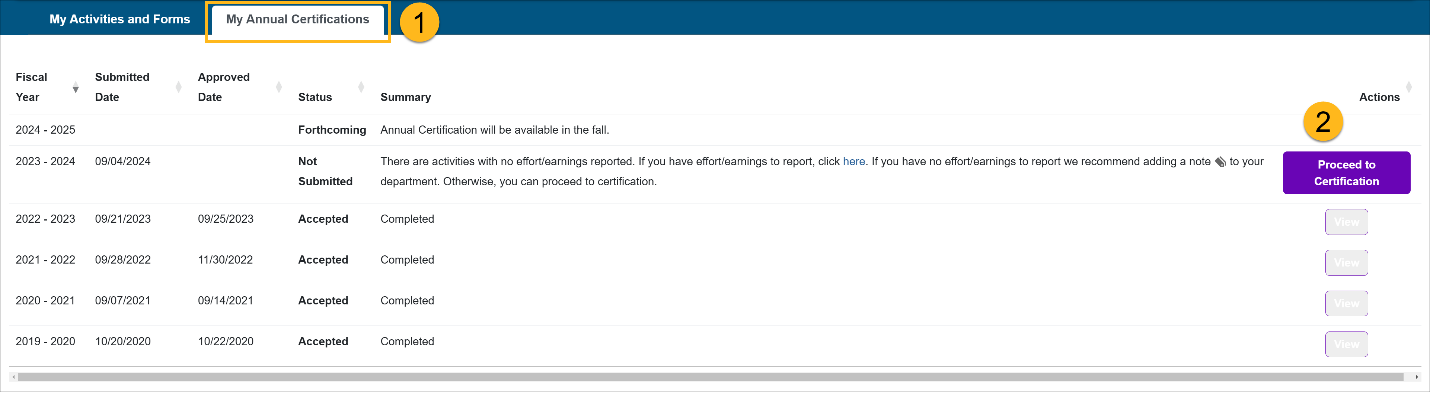
- Navigate to the fiscal year you are certifying, then click the Proceed to Certification button. Note: A message will appear if there are actions you need to take before you can submit your Annual Certification or to remind you to add effort to your activities.
- Confirm that the list of reported activities is accurate and current. Enter your initials and then click Submit Annual Certification. Please note that you will receive an error message if a prior approval form has not been submitted. If you need to update your activities, click on the My Activities and Forms tab.
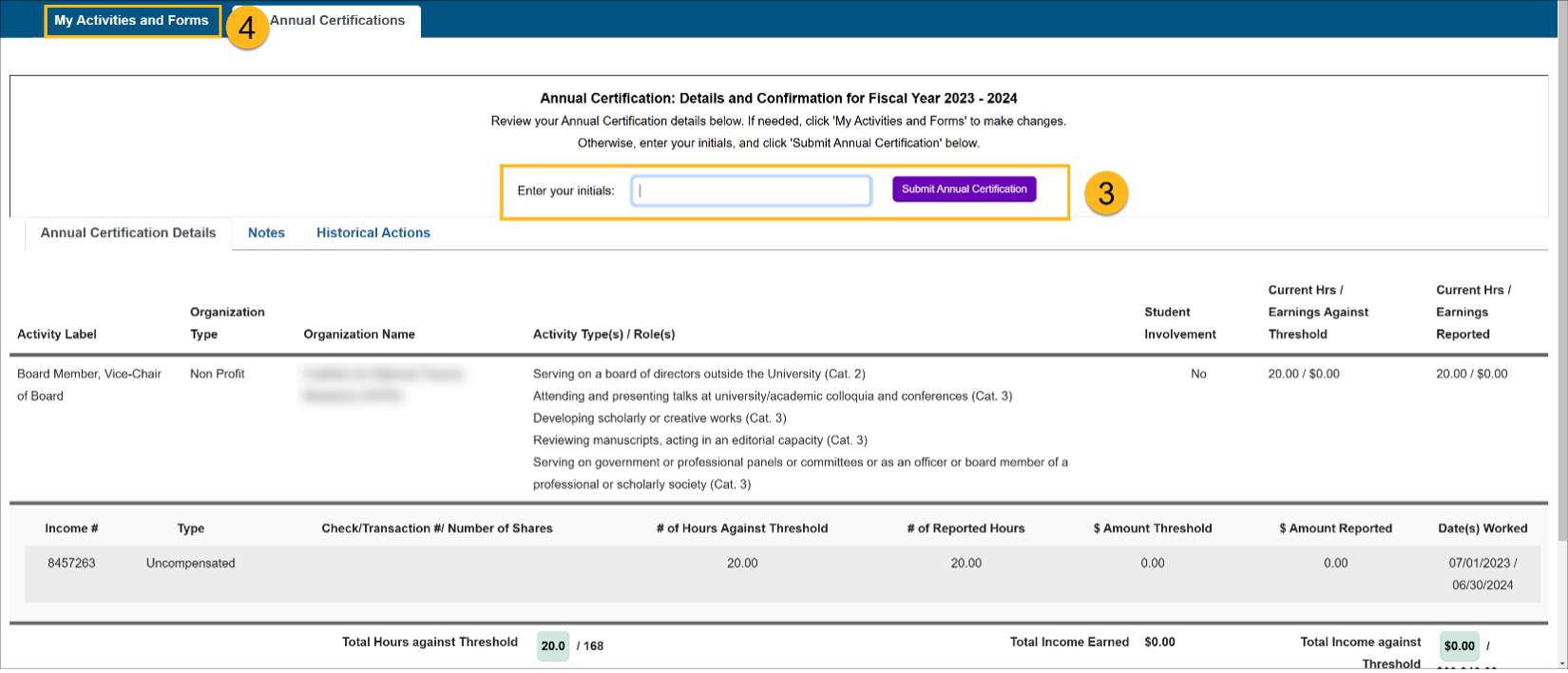
- Select the My Activities and Forms tab to return to your workspace.
Owner: Amy Friedli. Senior Director, SOM Office of Faculty & Academic Affairs
Approver: Christina Mangurian, Vice Dean, SOM Office of Faculty & Academic Affairs
Approval date: 5/1/26